
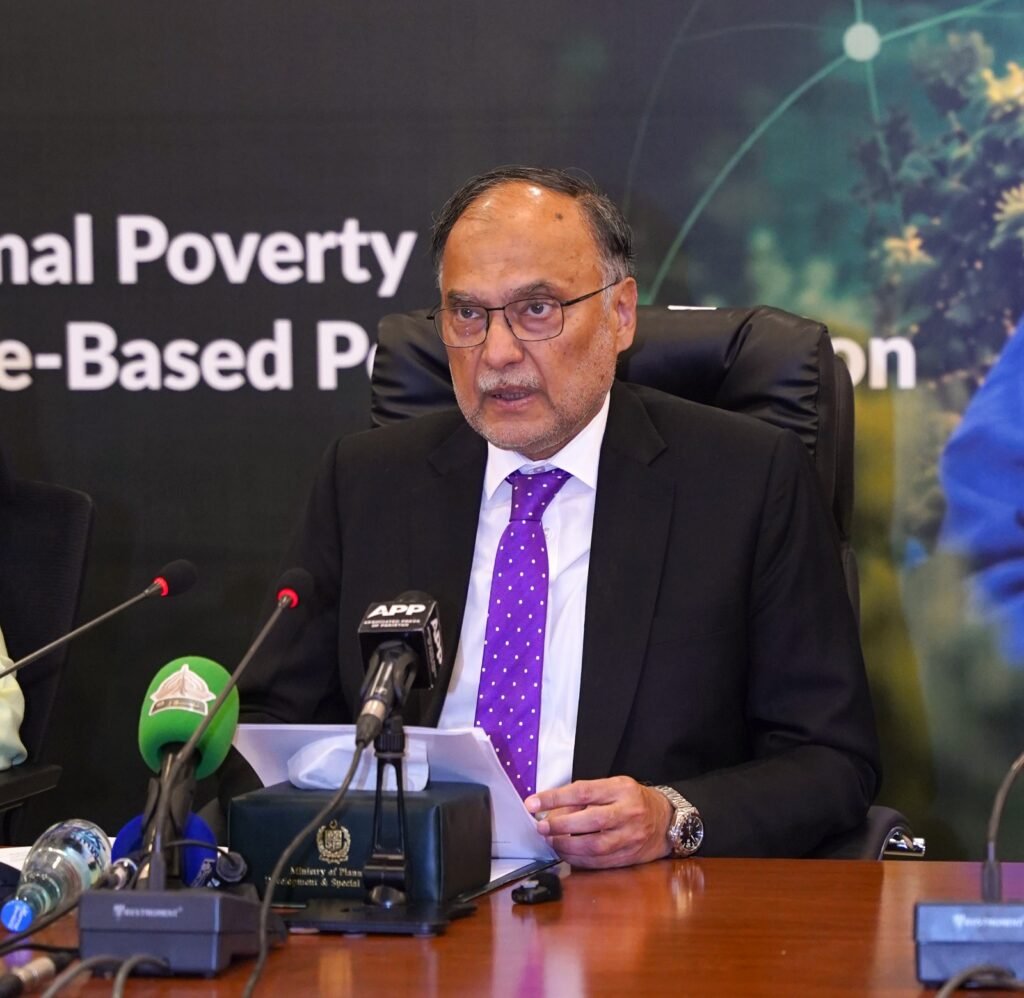
ISLAMABAD, Oct 28 (APP): Federal Minister for Planning, Development and Special Initiatives Professor Ahsan Iqbal on Wednesday said Pakistan’s poverty reduction momentum had suffered a serious setback after 2018, with the poverty rate rising to 28.9 per cent in 2024-25 from 21.9 per cent in 2018-19, amid political instability, economic crises, policy discontinuity and climate disasters.
Addressing an event titled “Pathways to a Poverty-Free Pakistan: Advancing Multidimensional Poverty Measurement for Evidence-Based Policy and Action,” the minister called for evidence-based policies, targeted public investment and sustainable poverty reduction.
Among others, the event was attended by Oxford Poverty and Human Development Initiative (OPHI) Director Professor Sabina Alkire, government officials, development partners, researchers and academics.
Ahsan Iqbal said monetary poverty fell from 29.5 per cent in 2013-14 to 24.3 per cent in 2015-16 during the PML-N government’s 2013-18 tenure, when economic growth, development investment, and human development remained key priorities under Vision 2025.
However, political uncertainty, interrupted development policies, the COVID-19 pandemic, devastating floods and severe macroeconomic pressures, including the threat of financial default in 2022, had undermined earlier gains, he said, stressing that political stability, sustained economic growth and policy continuity were essential to reversing the trend.
Highlighting constraints on development financing, the minister said the federal Public Sector Development Programme (PSDP) stood at Rs1,001 billion in 2017-18, equivalent to 19.6 per cent of the federal budget and 2.5 per cent of GDP. The allocation for 2026-27 remained around Rs1 trillion in nominal terms, despite population growth, rising prices and expanding development needs.
Had the 2017-18 share of the federal budget been maintained, the development programme would now exceed Rs3 trillion, he said, warning that limited public investment was affecting education, healthcare, water security, infrastructure, skills development and economic opportunities, particularly in disadvantaged regions.
The minister also called for completing the devolution process under the 18th Constitutional Amendment, noting that provinces received 57.5 per cent of the federal divisible pool under the 7th National Finance Commission Award and held primary responsibility for education, healthcare and social welfare.
However, the expanded fiscal space had not consistently translated into the required improvements in essential public services.
He stressed that Article 140A must be implemented meaningfully by transferring political, administrative and financial authority to elected local governments, supported by functional Provincial Finance Commissions and transparent, needs-based resource allocations.
Recalling Pakistan’s collaboration with Oxford, Professor Iqbal said the country launched its first National Multidimensional Poverty Index (MPI) in 2016 in partnership with OPHI and the United Nations Development Programme (UNDP).
The index assessed overlapping deprivations in education, health and living standards beyond monetary poverty.
The MPI helped identify Pakistan’s 20 poorest districts, including 11 in Balochistan, five in Sindh, three in Khyber Pakhtunkhwa and one in Punjab, providing a basis for targeted development initiatives under the federal PSDP.
Building on that experience, the government plans to develop the National MPI 2027 in collaboration with OPHI, the Pakistan Bureau of Statistics (PBS) and development partners, using data from the ongoing Pakistan Social and Living Standards Measurement Survey 2026-27.
The updated assessment would examine emerging challenges, including climate vulnerability, insecurity, youth deprivation, gender inequality, digital exclusion, early childhood development, nutrition, stunting and migration. The minister emphasised that new indicators and thematic studies must be backed by reliable data and sound methodology.
He said the proposed collaboration would also explore multidimensional poverty analysis at National and Provincial Assembly constituency levels, drawing on the 2023 Population and Housing Census. Such evidence could help elected representatives identify local development gaps, strengthen public accountability and build consensus on social investment.
Ahsan Iqbal called on the Planning Commission, PBS, Benazir Income Support Programme (BISP), Pakistan Institute of Development Economics (PIDE), provincial planning departments, academia and development partners to integrate poverty evidence into development planning, PSDP prioritisation, social protection and monitoring of development outcomes.
The proposed partnership would also examine the relationship between monetary and multidimensional poverty, strengthen institutional capacity and improve the use of poverty data in resource allocation and social protection targeting.
He said Pakistan’s poverty reduction agenda under URAAN Pakistan must combine macroeconomic stability with sustained investment in human development, stronger institutional accountability and equal opportunities for citizens.
The success of development policy, he added, should be measured not merely through public expenditure or completed projects, but by tangible improvements in education, health and livelihoods and by families’ ability to escape multidimensional poverty.
Source: APP (Associated Press of Pakistan)