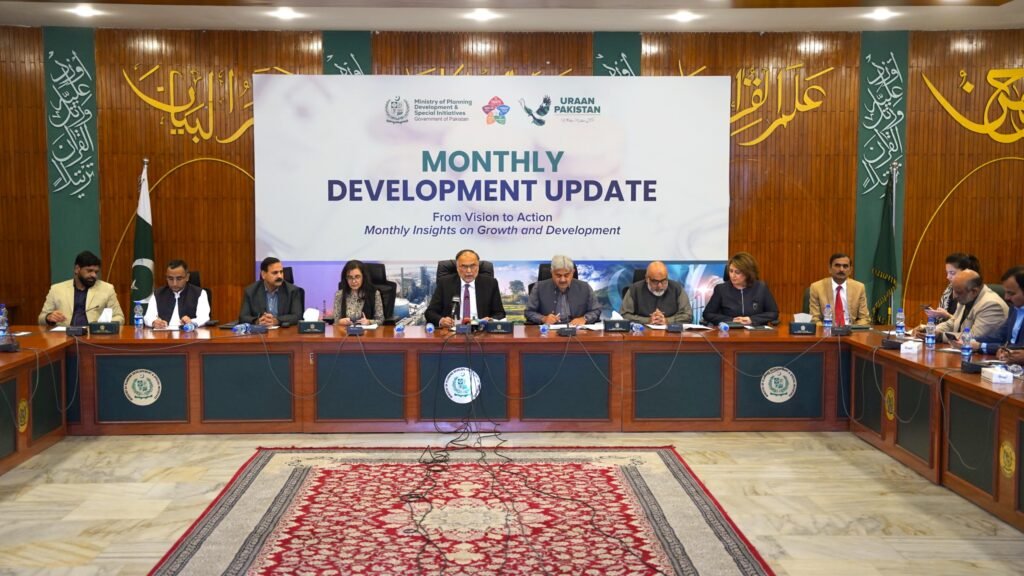
ISLAMABAD, Oct 29 (APP): Federal Minister for Planning, Development and Special Initiatives Professor Ahsan Iqbal on Thursday highlighted Rs14.5 billion in savings from development projects during the first quarter of FY2026-27, increased federal funding for newly merged districts of Khyber Pakhtunkhwa and growth in exports, stressing the need for export-led economic transformation.
Presenting the Monthly Development Update for October 2026, the minister said merchandise exports rose by 7.7 per cent to $8.5 billion during July-September, while combined exports of goods and services increased by 11 per cent to $11.2 billion, supported by 22.8 per cent growth in services exports.
ICT exports reached $1.2 billion, while workers’ remittances increased by 14 per cent to $10.9 billion.
He emphasized that Pakistan must expand its export capacity, diversify products and strengthen domestic value chains to reduce external vulnerabilities and achieve sustainable economic growth.
Ahsan Iqbal said Pakistan recorded 3.7 per cent GDP growth in FY2025-26, while the government was targeting four per cent growth in the current fiscal year.
Large-scale manufacturing registered 1.9 per cent growth during the first two months of FY2026-27, with 12 of 22 industrial groups reporting positive growth.
He said the government must ensure that rising imports, including machinery and raw materials, translate into higher domestic value addition and exports.
He stressed that sustained annual growth of five to six per cent was necessary to generate sufficient employment, but warned that consumption- and import-led expansion would not be sustainable without stronger exports.
The minister said rigorous scrutiny of development projects had generated savings of Rs7 billion in September, taking cumulative savings to Rs14.5 billion during the first quarter.
The Planning Commission would continue to eliminate unnecessary costs, improve project design and ensure efficient utilization of public funds.
During the quarter, Rs61.3 billion was utilized under the Public Sector Development Programme, including Rs13.4 billion in the water sector, Rs12.6 billion in transport and communications, and Rs7.8 billion in education, including the Higher Education Commission.
Responding to questions about funding for Khyber Pakhtunkhwa’s newly merged districts, the minister rejected the impression that allocations had been reduced.
He said the federal government had provided Rs118 billion under the Accelerated Implementation Programme over the past four years, compared with Rs82 billion during the previous government’s corresponding four-year tenure.
He said Rs8 billion had been provided for police infrastructure in the previous year, while another Rs7 billion was being allocated in the current year, taking the total to Rs15 billion. A steering committee had also been established to strengthen oversight and ensure that development funds directly benefited local communities.
The government would prioritize education, healthcare, skills development and employment opportunities for local youth. On the prime minister’s directives, a project to provide solar energy to 50,000 homes in the newly merged districts would commence soon, he added.
Highlighting the need for relief amid rising living costs, Ahsan Iqbal said around 12.7 million people had registered under the government’s targeted relief initiative.
He said a committee comprising government representatives, including Deputy Prime Minister Ishaq Dar, himself and Rana Sanaullah, as well as representatives of Jamaat-e-Islami, would examine options for extending relief and develop proposals for a phased reduction in the petroleum levy in the next budget.
He said the government was strengthening market surveillance to curb excessive wholesale-retail margins and profiteering, while ensuring that relief measures remained sustainable amid uncertainty over international energy prices.
The minister also called for stronger, constitutionally protected local governments, advocating the devolution of administrative and financial powers to district-level institutions to improve service delivery in education, healthcare and other social sectors.
Reaffirming the government’s commitment to technology-led growth, he highlighted the launch of Quantum Valley Pakistan, aimed at bringing academia, industry, entrepreneurs and investors together to develop the country’s quantum technology ecosystem.
He also cited progress in semiconductor skills development, the completion of Islamabad Technology Park and preparations for Karachi Technology Park.
Ahsan Iqbal said the five Es of URAAN Pakistan,Exports, E-Pakistan, Environment and Climate Change, Energy and Infrastructure, and Equity and Empowerment, provided the framework for transforming economic stabilization into inclusive and sustainable development.
Source: APP (Associated Press of Pakistan)