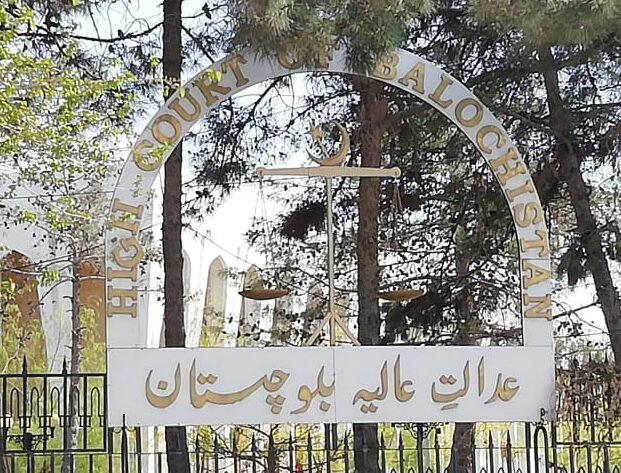
QUETTA, Oct 29 (APP): The Balochistan High Court (BHC) on Thursday took notice of the lack of drinking water supply in Hazara Town and Hazarganji, ordering the relevant authorities to appear in person and submit a comprehensive report.
A two-member bench, comprising Chief Justice of the Balochistan High Court, Justice Muhammad Kamran Khan Mulakhail, and Justice Muhammad Najam-ud-Din Mengal, expressed concern over the delay by the relevant authorities in implementing court orders.
The bench was hearing a constitutional petition concerning the provision of drinking water in Hazara Town, Karkhasa, and Hazarganji, as well as the alleged monopoly held by private tube-well owners.
During the proceedings, Chief Justice Muhammad Kamran Khan Mulakhail remarked that the constitutional petition was filed on September 21, 2023, however, despite multiple orders and repeated directives issued by the court on various occasions, no significant progress has been made by the Quetta Water and Sanitation Authority (QWASA).
In response to the court’s inquiry, the Executive Engineer of WASA stated that tube-wells in the Karkhasa area have been made operational, additionally, there are two water reservoirs with capacities of 300,000 and 200,000 gallons through which drinking water is being supplied to areas where a pipeline network exists.
He further informed the court that the installation of 11 tube-wells in the Hazarganji area has also been completed, however, the work faced interruptions due to certain administrative and official issues, following the arrest of Quetta Electric Supply Company (QESCO) personnel by the police. An NOC has now been issued in favor of WASA, and it is expected that the remaining necessary work would be completed within the next five to six months.
On the other hand, the petitioner’s counsel, speaking on behalf of local residents, particularly those in Hazara Town refuted WASA’s stance.
He informed the court that residents still lack access to adequate drinking water, and that private tube-well owners have allegedly established a monopoly over the water supply.
According to him, despite making monthly payments, the residents remain deprived of a government-provided water supply, while private tube-well owners continue to sell water.
The petitioner’s counsel further argued that, despite court orders issued on October 9, 2025, and December 1, 2025, no effective measures have been taken to prevent private tube-well owners from utilizing WASA’s pipelines or selling water.
Consequently, the problems being faced by the local residents persist.
In light of these circumstances, the court directed the Commissioner of the Quetta Division, the Deputy Commissioner of Quetta, the Managing Director of WASA, the Chief Engineer of WASA, the Secretary of Public Health Engineering (PHE), and other relevant officials to appear in person at the next hearing and submit a comprehensive report.
The Court specifically directed the Deputy Commissioner of Quetta in his capacity as the Chairman of the Balochistan Groundwater Rights to submit a report detailing the total number of operational tube wells in the area, their specific particulars, and their legal status.
Furthermore, it must be clarified whether the owners of these tube wells possess No Objection Certificates (NOCs) issued by the competent authorities. Additionally, the Court instructed the legal counsel for WASA to place on the judicial record the legal advice provided regarding B-WASA.
It was further ordered that copies of the Court’s directive be forwarded to the relevant authorities and the office of the Advocate General of Balochistan for their information and compliance.
Adjourning the hearing of the case until November 2, 2026, the Court ordered the concerned authorities to ensure the implementation of these directives.
Source: APP (Associated Press of Pakistan)