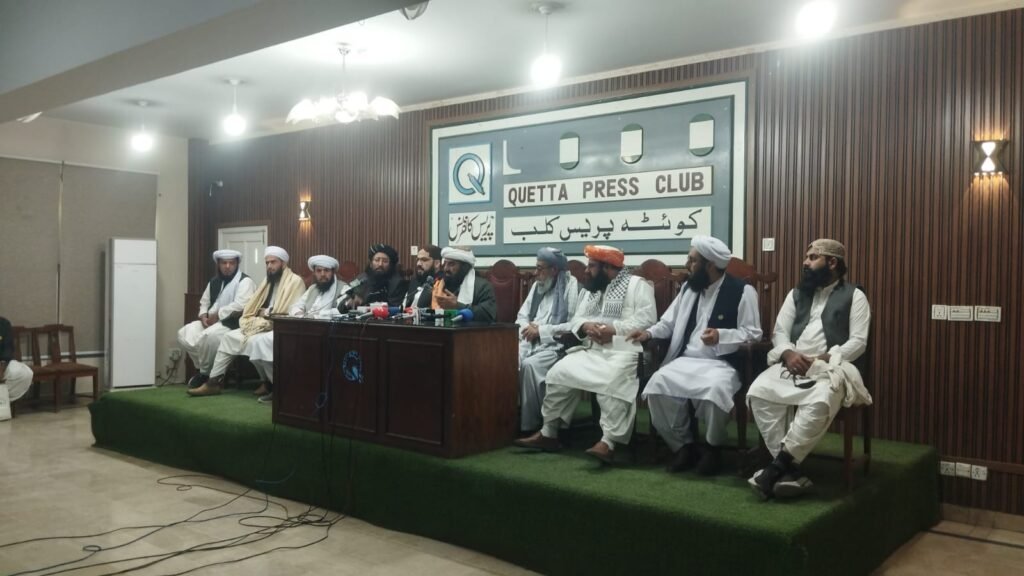
QUETTA, Nov 21 (APP): Ulema from across Balochistan on Saturday strongly demanded the autonomy and apolitical identity of religious seminaries, saying that these institutions are a collective asset of the entire Muslim Ummah and cannot be used for political interests.
Addressing a joint press conference at the Quetta Press Club here, Dr. Hafiz Allaudin Sarang of Jamiat Ulema-e-Islam-Fazl (JUI-F) and Qari Maher Ullah of Jamiat Ulema-e-Islam-Nazriati (JUI-N) along with a huge number of Ulema said that religious seminaries cannot be treated as the personal property or fiefdom of any individual, family, organization, or political party.
Dr. Sarang emphasized that the primary purpose of establishing madaris is the teaching of the Quran and Sunnah, the promotion of Islam, the protection of Islamic values, and the moral and spiritual upbringing of the new generation.
Dr. Sarang asserted that neither JUI-F nor any other political party has the right to monopolize seminary representation or use these institutions for electoral, organizational, or political gains.
He firmly opposed turning madaris into centers of political power or using their platforms for political protests, agitation, or confrontation against the government and state institutions.
“The sanctity, academic dignity, and neutral identity of seminaries will not be sacrificed for political interests,” he said, adding that using seminary students for personal agendas and political conflicts is unacceptable.
Dr. Sarang urged the JUI-F to allow students to focus on their education rather than using them as “political fuel.”
He criticized the practice of doing politics in the name of poor seminary students while neglecting their educational and economic futures.
He noted that while politics is done in the name of poor students, JUI-F awards Senate and other election tickets to billionaires, adding that there is currently no religious scholar affiliated with JUI-F in the Balochistan Assembly.
Claiming that a majority of Balochistan’s religious scholars and seminary administrators stand with their stance against political monopoly, Dr. Sarang pointed out that political interference is a major reason why seminaries are deprived of government patronage and resources.
He stressed that decisions regarding the future of madaris and their boards (Wafaqs) should be made through collective consultation and mutual respect among all relevant religious circles, rather than single-party dominance.
Highlighting that religious seminaries belong to Pakistan rather than any political party, he urged the government to officially recognize madaris as a vital part of the national education system and take practical steps for their development.
He demanded that the state take responsibility for the students’ future by equipping seminaries with modern contemporary education, computers, laptops, and the latest technology to bring them in line with modern requirements.
Furthermore, he called upon the government to bear the financial burden of seminary teachers’ salaries to resolve financial issues and improve educational standards.
He sid that their struggle is solely dedicated to safeguarding the freedom, autonomy, and apolitical character of religious seminaries.
Source: APP (Associated Press of Pakistan)