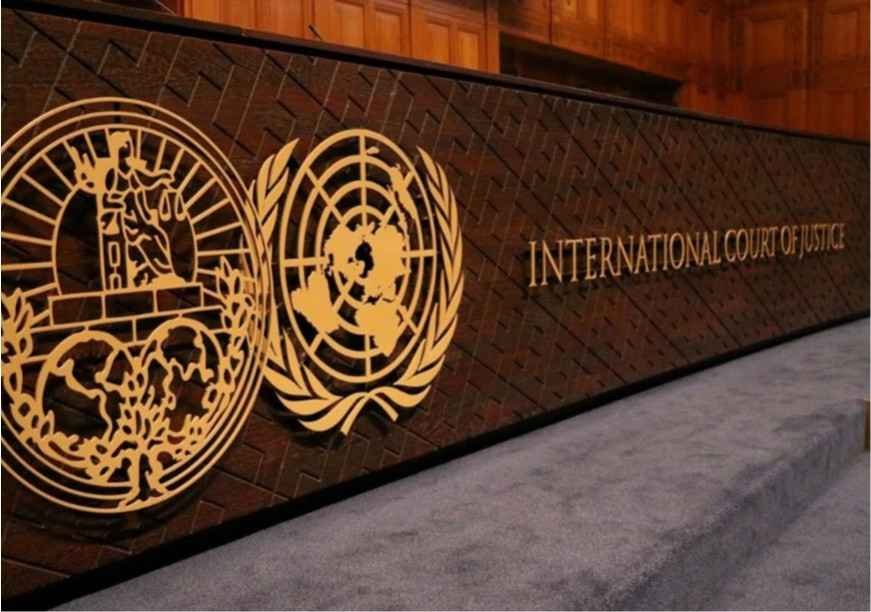
UNITED NATIONS, Nov 19 (APP): The International Court of Justice, the principal judicial organ of the UN, delivered its judgment on Thursday in the case of The Gambia versus Myanmar on the application of the Genocide Convention, finding Myanmar responsible for the crime against the country’s ethnic Rohingya Muslims, the first such ruling against a State.
At the end of a three-hour ruling at the International Court of Justice (ICJ) in The Hague, President Yuji Iwasawa of Japan also declared that Myanmar had failed to prevent and punish genocide, after detailing how Myanmar’s military had perpetrated “extreme violence” against mainly Muslim Rohingya communities in Rakhine state.
UN Secretary-General Antonio Guterres welcomed the judgment as a “powerful recognition of the Rohingya victims of genocide. It is a demonstration of international justice and a reaffirmation that impunity for such horrific acts must not stand.”
The UN chief stressed that ending impunity in Myanmar and ensuring accountability remained essential to national reconciliation and added that the judgment “will be studied carefully within the United Nations. International law, including the Genocide Convention, must be respected by all.”
The ruling establishes that Myanmar’s security forces “and other State organs” intentionally committed specifically prohibited acts covered by Article II of the Genocide Convention.
These are Article II(a) – killing members of a group, Article II(b) – causing seriously bodily or mental harm to members of the group and Article II(d) – imposing measures intended to prevent births within the group.
The ICJ ruling came after studying graphic evidence and testimonies provided by survivors and reports from international investigators describing how Rohingya villages and bridges had been set alight and bulldozed, with men and boys executed and girls and women raped during military clearance operations in northern Rakhine in 2017.
The military clearance operations also involved the murder of infants, which “supports the inference that Myanmar’s security forces acted with the intent to prevent births among the group”, Judge Iwasawa continued.
Delivering the court’s ruling, the ICJ President described how the mainly Muslim Rohingya living in Rakhine state in western Myanmar had been the target of successive clearance operations by the State military, after decades of intercommunal violence.
The 2017 clearance operations prompted widespread international condemnation after some 700,000 Rohingya fled northern Rakhine state across the border to Bangladesh.
A group of Rohingya refugee children looking at the camera during a visit to a Multi-purpose Centre for Children and Adolescents in a refugee camp in Cox’s Bazar.
The case at the ICJ was initiated by The Gambia in November 2019; it has become one of the most closely watched proceedings before the world’s highest court.
Related to the exodus and mass killings, rape and other sexual violence, the court heard testimonies from three witnesses from the Rakhine state villages of Min Gyi, Chut Pyin and Maung Nu.
In addition, one witness called by Myanmar gave an account of an attack in which Rohingya insurgents the Arakan Rohingya Salvation Army (ARSA) allegedly killed around 100 civilians.
The court heard that nearly 400 villages – approximately 40 per cent of the almost 1,000 villages in the three townships of northern Rakhine state – were partially or totally destroyed during and after the 2017 clearance operations.
“Bulldozing and large-scale terrain clearance often followed the destruction…in turn, rapid construction took place on the cleared sites, including security installations, new villages and houses, and other civilian infrastructure,” Judge Iwasawa explained.
As a consequence of these breaches of the Genocide Convention, the Court ordered Myanmar: to cease any ongoing violations by enacting legislation giving full effect to its obligations under the Convention; to take immediate and effective steps to investigate all persons reasonably suspected of having committed acts contrary to the Convention and, if warranted, to prosecute and punish them.
In addition, the ruling orders Myanmar to provide assurances and guarantees of non-repetition and prevent similar violations from occurring in the future; to adopt measures of restitution in the interest of the Rohingya, including allowing the safe, voluntary and dignified return to their place of residence and reunification of families for the Rohingya who were displaced as a result of the Respondent’s wrongful acts, whether they were displaced within Myanmar or abroad; and to compensate the Rohingya group and its members for the damage caused.
Finally, the Court decided that the question of the amount and the modalities of compensation or other reparation should be determined in a subsequent phase of the proceedings, and that, to that end, Myanmar should transmit to it, within two years of today’s Judgment, a report on the measures of restitution it has adopted and the amount and modalities of compensation.
The judgment is final, binding on the parties to the case and without appeal.
Source: APP (Associated Press of Pakistan)