ISLAMABAD, Nov 20 (APP):Minister of State for Finance and Railways Bilal Azhar Kayani on Friday said the government’s transparency-driven interventions, including production monitoring and track-and-trace systems, had generated an additional Rs100 billion to Rs150 billion in tax revenue by curbing tax evasion in key industrial sectors.
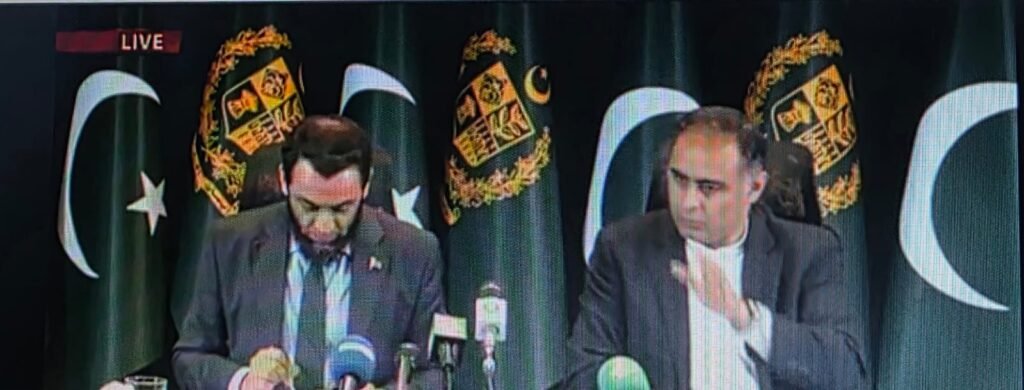
Addressing a news conference along with Federal Minister for Law and Justice Senator Azam Nazeer Tarar and Federal Minister for Information and Broadcasting Attaullah Tarar, he said the government had placed special emphasis on transparency, merit and third-party verification in policy formulation and implementation under the leadership of Prime Minister Shehbaz Sharif.
He said production monitoring and track-and-trace systems had helped curb tax evasion, particularly in sectors with significant vested interests, including tobacco, where under-reporting of production and evasion of sales and income taxes had been prevalent.
“The additional tax collection of Rs100 billion to Rs150 billion has been achieved only as a result of this intervention,” he said.
He said the systems had been implemented in the sugar, tobacco, cement and tiles sectors, while work was under way in beverages, textiles, iron and steel, paper and board, and hatcheries.
The minister said the interventions aimed to prevent under-reporting of production and curtail discretionary powers of field officers to minimise opportunities for irregularities.
Explaining other transparency measures, he said the government had introduced faceless customs clearance, under which importers could no longer directly interact with appraisers, while customs assessments were conducted anonymously.
Similarly, the government had approved a new tax operating model in June, under which income tax audit and assessment functions were being made completely faceless and anonymous to minimise discretionary powers at Regional Tax Offices (RTOs).
He said the process would be driven by customer relationship management (CRM), artificial intelligence and backend data, while field officers’ role would largely be restricted to enforcing audit and assessment outcomes.
Highlighting the government’s cashless initiative, he said efforts were also under way to digitise payments to contractors, employees and pensioners to eliminate unnecessary physical interaction between citizens and government officials.
Bilal Azhar Kayani said the National Risk Assessment on Corruption Vulnerabilities and Mitigation Plan report was expected to be uploaded for public scrutiny.
Responding to a question about rightsizing and devolution, he said the government was making serious efforts to reduce administrative expenditure by identifying and merging institutions performing overlapping functions.
He cited the closure of Utility Stores Corporation and Pakistan Public Works Department (PWD), along with the process initiated to wind up the Pakistan Agricultural Storage and Services Corporation (PASSCO), as examples of the rightsizing exercise.
He said the government was also focusing on reducing non-employee-related expenditure without affecting the salaries of lower-grade government employees, particularly those in grades 1 to 16.
Replying to another question, he said the government was strongly committed to reducing the tax burden, particularly on salaried individuals, who had been paying more than their fair share.
He said the government had provided around Rs400 billion in tax relief in the current year’s budget, with the salaried class among the major beneficiaries.
He added that the government aimed to reduce reliance on indirect taxation, including petroleum levies, subject to available fiscal space.
The minister said efforts were also under way to broaden the tax base, strengthen production monitoring and curb tax evasion, while improving the disposable income and living conditions of ordinary citizens.
Source: APP (Associated Press of Pakistan)