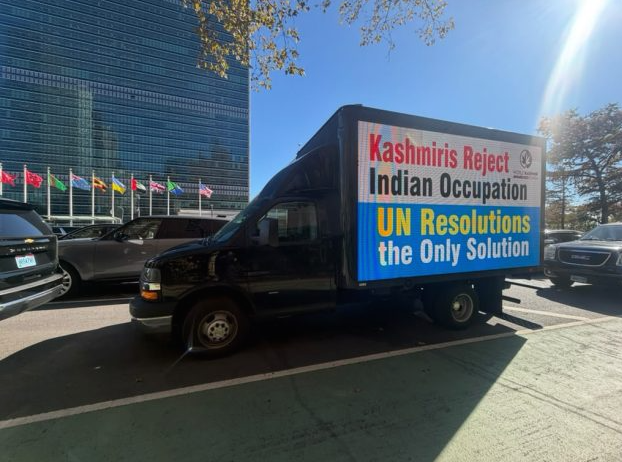
NEW YORK, Oct 28 (APP):Digital advertising trucks flashing messages about Kashmir’s disputed status, human rights, and the right to self-determination rolled through key locations in New York City, such as Times Square and United Nations headquarters, as Kashmiris and their supporters marked October 27 as the day of occupation.
Organized by the Washington-based World Kashmir Awareness Forum (WKAF), the trucks were deployed to draw international attention to the longstanding Kashmir dispute and urge renewed efforts toward a peaceful, just, and lasting settlement involving India, Pakistan, and the people of Jammu and Kashmir.
Electronic screens mounted on the trucks displayed messages including: “No Election, No Selection: UN Resolutions Only Solution”; “India: Stop Land Grabbing in Kashmir”; “Kashmiris Demand Right of Self-Determination”; “Kashmiris Reject Indian Occupation: UN Resolution Only Solution”; “Indian Army Out of Kashmir”; and “India: Release Political Prisoners Unconditionally.”
Other messages highlighted the unresolved status of the territory and called on the international community to renew diplomatic efforts toward a settlement consistent with the aspirations and rights of the Kashmiri people.
The vehicles also traveled past Rockefeller Center, the Freedom Tower, the Empire State Building, and various missions accredited to the United Nations.
Dr. Ghulam N. Mir, president of the World Kashmir Awareness Forum and executive producer of Saffron Kingdom, said Kashmiris observe October 27 as a day of grief, remembrance, and protest because Indian troops entered Jammu and Kashmir on October 27, 1947, amid the unresolved dispute over the territory’s accession.
Dr. Mir questioned the historical circumstances surrounding the Instrument of Accession and cited British historian Alastair Lamb’s writings, which challenged the accepted account of the document and its historical provenanc
Dr. Imtiaz Khan, a Kashmiri American scholar, said developments in recent years had intensified concerns about Kashmir’s political identity, land rights, and demographic future.
He pointed to the Indian government’s August 2019 revocation of Jammu and Kashmir’s special constitutional status and subsequent changes to domicile and land regulations. Critics of these policies argue that they could weaken local political control and alter the region’s demographic balance.
Dr. Ghulam Nabi Fai, chairman of the World Forum, said the people of Jammu and Kashmir had endured decades of conflict, displacement, political uncertainty, and allegations of human rights abuses.
He called for credible, independent investigations into allegations of excessive force, arbitrary detention, enforced disappearances, sexual violence, and other serious violations, emphasizing that accountability and due process should apply regardless of political affiliation.
“A durable settlement cannot emerge simply by imposing one side’s narrative on the other,” Dr. Fai said. “It requires meaningful dialogue, respect for human rights, and a genuine commitment to resolving the dispute peacefully.”
Sardar Taj Khan, the principal organizer of the digital truck campaign and senior vice chairman of Kashmir Mission, USA, said the Kashmir dispute should not be viewed solely through the lens of India-Pakistan relations. He argued that the future of Jammu and Kashmir must also reflect the rights, political aspirations, and freely expressed wishes of its people.
“The Kashmir dispute cannot be resolved by treating it exclusively as a bilateral territorial contest or by excluding Kashmiris from decisions about their own future,” Sardar Taj Khan said. “A peaceful settlement requires meaningful participation by the Kashmiri people, sustained engagement between India and Pakistan, and constructive international diplomacy.”
Mohammad Ahmed Hasan, an eighth-grade student, Syed Hasan Raza, a human rights activist, Raja Razak, a prominent leader of Muslim League (N), also spoke in support of Kashmiris’ struggle to end India’s occupation.
Source: APP (Associated Press of Pakistan)