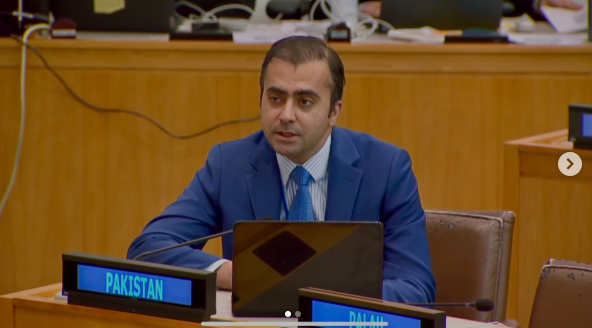
UNITED NATIONS, Oct 25 (APP):Pakistan has warned that artificial intelligence (AI) systems operating without effective human judgment and control dramatically increase the risks of military miscalculation and rapid conflict escalation.
“Without effective human judgement and control, these systems increase the risks of miscalculation and escalation, lower the threshold for the use of force, and erode compliance with international humanitarian law (IHL),” Pakistani delegate Husham Ahmed told the General Assembly’s First Committee, which is examining how the malicious use of information and communications technology (ICT) threatens global peace and security.
Ahmed, a counsellor at the Pakistani Mission to UN offices in Geneva, emphasized that AI-enabled targeting and decision-support tools are no longer a future prospect but are already being deployed at scale in active global conflicts.
In this regard, he called for inclusive, UN-led governance frameworks to prevent the technology from compressing military response windows to dangerous levels, particularly in regions where conventional and nuclear capabilities are closely entangled.
“These dangers are acute in regions of close conventional-nuclear entanglement, where one nuclear-armed State has deployed autonomous loitering munitions and dual-capable missiles against another,” the Pakistani delegate said.
“The decision to employ nuclear weapons must always remain in human hands,” Husham Ahmed said.
“The risks of AI-enabled capabilities in areas of close conventional-nuclear entanglement must be holistically addressed. Military AI governance must be anchored in the UN; initiatives outside the UN cannot replace its legitimacy, inclusivity, and universality.”
Earlier, Egriselda López (El Salvador), the Chair of the Global Mechanism on developments in the field of information and communications technologies and advancing responsible State behaviour in the use of information and communications technologies, said, “The establishment of the global mechanism is a milestone over more than two decades of intergovernmental debates on the security of ICT” at the United Nations.
Lopez noted that threats related to ICTs continue to evolve and affect States across all regions, regardless of their level of technological development. Their impact extends beyond digital systems, disrupting essential services, hindering economic development and undermining international peace and security, she warned.
“Addressing these challenges requires the collective attention and participation of all States in an open and inclusive forum,” she said.
Source: APP (Associated Press of Pakistan)