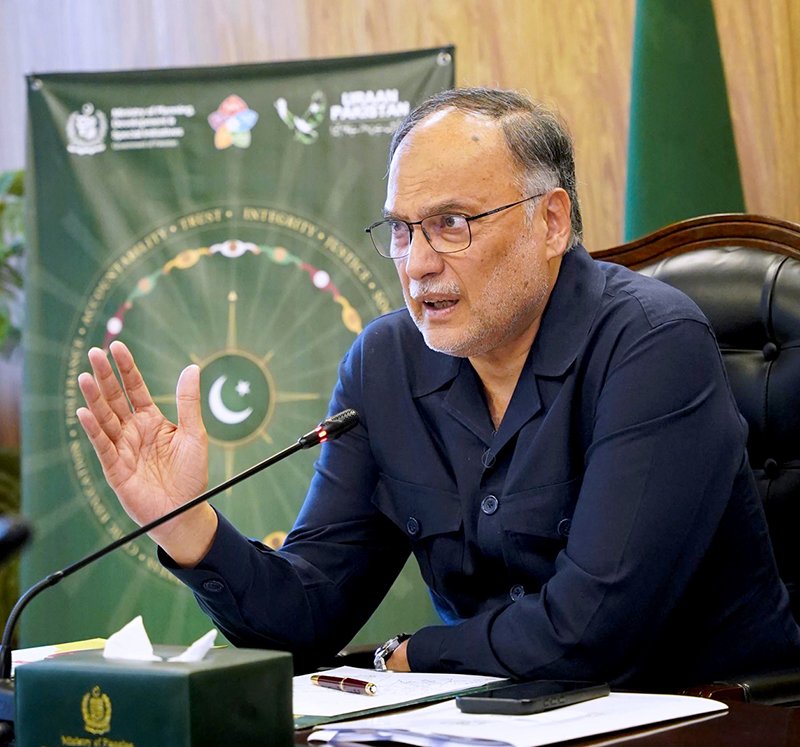
LAHORE, Oct 24 (APP):Federal Minister for Planning,Development and Special Initiatives Ahsan Iqbal on Saturday urged young doctors to contribute to Pakistan’s development through research,modern technology and the promotion of knowledge, while avoiding fake news and propaganda on social media and protecting patients’ confidential information.
Addressing the seventh convocation 2026 of Rashid Latif Medical and Dental College as chief guest, he said Pakistan had achieved significant successes since its establishment, but sustainable development required continuity in economic policies,evidence-based decision-making and the promotion of research and innovation.
Congratulating the graduates, he said their hard work and achievements would lay the foundation for their effective role in the country’s future.
Medicine was a profession in which people’s lives and health depended on doctors’ knowledge, skills and expertise, he added.
He said doctors could help mothers recover and care for their children, enable fathers to continue supporting their families, and restore happiness to children and their parents through effective treatment.
The minister said a convocation was not merely an occasion for celebration but also an opportunity to recognize professional and social responsibilities.
The success of graduates from private medical colleges reflected the sacrifices of their parents, who curtailed their own needs to ensure their children’s education. He urged the graduates to remember these sacrifices throughout their lives.
Appreciating the services of teachers, Ahsan Iqbal said parents and teachers were among those who genuinely rejoiced in seeing their children and students surpass them. He stressed that they should always be treated with respect.
He said technological advancements were accelerating rapidly and innovations expected over the next five years could surpass those introduced during the previous 50 years.
Following the internet revolution, artificial intelligence had brought another major transformation, with its role expanding across all fields of life.
Modern technologies, including robotic surgery, were also creating new possibilities in medical sciences.
He said Pakistan needed to decide whether it would remain a consumer of technologies developed by other countries or become a nation capable of generating knowledge, conducting research and producing its own technology.
Maintaining that Pakistan had no shortage of talent and intelligence,he said young people needed to engage in research and develop innovations that addressed national needs and contributed to economic growth.
Referring to the Muslim era in Andalusia, he said knowledge and research had flourished under Muslim rule, with Cordoba and other centers emerging as prominent hubs of learning.
However, the Muslim world subsequently fell behind in research and knowledge after moving away from that intellectual tradition.
He said nations advanced by investing in knowledge and technology, as their innovations helped meet defense requirements and strengthen their economies.
The federal minister said Pakistan had achieved numerous successes despite considerable challenges since independence in 1947.
Despite limited resources and doubts about its future,the country had acquired nuclear capability, made progress in defense production, including the development of JF-17 aircraft, and established modern telecommunications infrastructure.
However,he observed that several countries had developed at a faster pace than Pakistan.
Citing South Korea, China and Vietnam as examples, he said Pakistan needed to assess its development trajectory and identify the reasons other nations had moved ahead.
He said that,just as a doctor diagnosed an illness accurately before prescribing treatment,the country needed to identify the obstacles hindering its development before finding appropriate solutions.
Ahsan Iqbal said Pakistan had faced serious challenges, including power outages and terrorism in 2013.
In subsequent years, electricity generation increased, measures were taken to overcome load-shedding, and billions of dollars in investment flowed into the country through the China-Pakistan Economic Corridor (CPEC).
However,he said subsequent policy changes affected investment. Had policy continuity been maintained, Pakistan could have attracted more Chinese industries seeking to relocate their operations.
Discussing the adverse effects of fake news and political polarization,he said misinformation hatred and prejudice could influence public thinking and create divisions in society.
He urged young people to verify information circulating on social media before believing or acting upon it and to adopt responsible online behaviour.
Referring to an attack on himself, he said hatred and prejudice could have damaging consequences for individuals and society.
The minister also cited the example of Quaid-e-Azam Muhammad Ali Jinnah’s personal physician, who maintained confidentiality during the founder of Pakistan’s illness.
He said doctors had a professional and ethical obligation to protect patients’ private information and medical records.
Referring to the Marka-e-Haq confrontation with India in 2025, Ahsan Iqbal said Pakistan had confronted its adversary under the leadership of Field Marshal Asim Munir and inflicted a decisive defeat.
He said some claims about Pakistan’s capabilities circulated on social media had proved contrary to reality, underscoring the need to remain cautious about online propaganda.
Referring to the conflict involving Iran and the United States,he highlighted the roles of the prime minister and Asim Munir saying Pakistan’s diplomatic efforts had received international appreciation.
He said the respect earned through Marka-e-Haq should be transformed into success in Marka-e-Taraqqi, enabling Pakistan to achieve prominence in knowledge, research, technology and economic development.
Addressing the graduates,he urged them to remember Pakistan wherever they lived and contribute to the country’s progress.
Chairman RLK Associates Prof.Dr.Rashid Latif Khan said healthcare professionals enjoyed a respected and distinctive position worldwide.
He said doctors were responsible for providing quality treatment to all patients without discrimination between rich and poor.
He stressed the need to improve healthcare professionals’ communication skills and urged doctors to speak politely and compassionately with patients and their attendants.
He added that Pakistan offered numerous opportunities for young people to succeed while staying in the country, but hard work was essential to avail themselves of these opportunities.
CEO Sabahat Khan said Pakistan remained the identity of its citizens wherever they went,adding that contributing to the country’s development and prosperity was a collective responsibility.
A total of 188 students received medals and degrees at the convocation, including 147 MBBS graduates from Rashid Latif Medical College and 41 BDS graduates from Rashid Latif Dental College.
University of Health Sciences Registrar Kiran Fatima attended the ceremony as guest of honour.
Executive Director Prof. Farrukh Zaman and Director Zulaikha Khan were also present.
Vice Principal Prof. Dr. Mudassar Ali administered the oath to the graduating students.
The ceremony concluded with the presentation of commemorative shields to distinguished guests.
Parents of the graduating students also attended the event.
Source: APP (Associated Press of Pakistan)