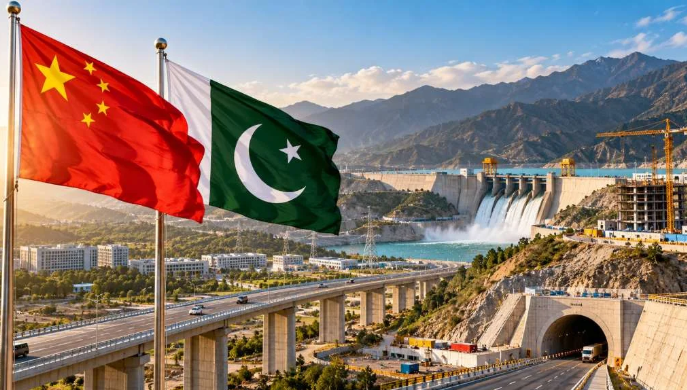
ISLAMABAD, Oct 23 (APP):China accounts for the largest share of Pakistan’s Rs8.099 trillion foreign-funded development portfolio, with six China-supported projects carrying a combined estimated cost of Rs2.539 trillion, representing approximately 31.4% of the total value of 98 projects being managed by the country.
According to official donor-wise figures for the fiscal year 2026-27, a copy of which is available with Wealth Pakistan, the Ministry of Planning, Development and Special Initiatives has listed 98 foreign-funded development projects with a combined estimated cost of Rs8.099 trillion.
The figures show that China leads all individual donors in terms of total project cost despite supporting only six of the 98 schemes. Estimated expenditure on these projects stood at Rs57.229 billion as of June 30, 2026, while the recorded throw-forward amounted to Rs2.482 trillion, indicating substantial expenditure remaining on the projects.
For the current fiscal year, the government has allocated Rs31.7 billion for China-supported projects, comprising Rs25.829 billion in rupee cover and Rs5.872 billion in local funding.
The International Development Association (IDA) ranks second in terms of total project cost, with nine schemes valued at Rs2.279 trillion, accounting for approximately 28.1% of the overall portfolio. Estimated expenditure on these projects reached Rs695.401 billion by June 30, 2026, while Rs60.075 billion has been allocated for 2026-27.
The Asian Development Bank (ADB) supports the highest number of projects among all donors, with 31 schemes involving a combined estimated cost of Rs1.131 trillion. Estimated expenditure on these projects stood at Rs396.357 billion, while the allocation for the current fiscal year amounts to Rs65.89 billion.
Similarly, the Islamic Development Bank is associated with three projects carrying a total estimated cost of Rs851.969 billion. Expenditure on these schemes reached Rs224.728 billion by June 2026, while Rs40.31 billion has been allocated for the ongoing fiscal year.
The donor-wise statement also identifies four projects under the multiple-donor category, involving a combined cost of Rs331.813 billion. These projects have received the highest annual allocation of Rs80.284 billion for 2026-27, including Rs23.584 billion in rupee cover and Rs56.7 billion in local funding.
Saudi Arabia supports three projects valued at Rs255.705 billion, while the Asian Infrastructure Investment Bank (AIIB) is associated with two projects costing Rs237.77 billion. Their respective allocations for the current fiscal year stand at Rs3 billion and Rs9.4 billion.
France is associated with seven projects worth Rs112.154 billion, with an allocation of Rs10.766 billion for 2026-27. South Korea also supports seven projects, carrying a combined estimated cost of Rs98.171 billion and an annual allocation of Rs12.02 billion.
Separate entries for the World Bank and the International Bank for Reconstruction and Development (IBRD) cover eight and six projects, respectively. The eight projects listed under the World Bank category have a combined estimated cost of Rs90.649 billion, while the six IBRD projects are valued at Rs40.482 billion.
The government has allocated Rs12.679 billion for projects listed under the World Bank category and Rs12.198 billion for IBRD-supported schemes during the current fiscal year.
Other development partners include Japan, the United States, Germany, Kuwait Fund, Italy and UN-Habitat, supporting projects of varying sizes across the development portfolio.
According to the official figures, estimated expenditure across all 98 foreign-funded projects reached Rs1.981 trillion by June 30, 2026, while the total recorded throw-forward stood at Rs5.294 trillion.
For fiscal year 2026-27, the government has allocated Rs345.625 billion for foreign-funded development projects, comprising Rs255 billion in rupee cover and Rs90.625 billion in local funding.
The highest allocation of Rs80.284 billion has been made for projects under the multiple-donor category, followed by Rs65.89 billion for ADB-supported schemes and Rs60.075 billion for IDA projects.
The figures indicate that while China dominates the total estimated cost of Pakistan’s foreign-funded development portfolio, annual budgetary allocations are distributed across a broad range of multilateral and bilateral development partners.
China’s substantial share of the portfolio also reflects the scale of development cooperation between the two countries, although the donor-wise statement does not provide a project-level breakdown of the sectors covered by the six China-supported schemes.
Source: APP (Associated Press of Pakistan)