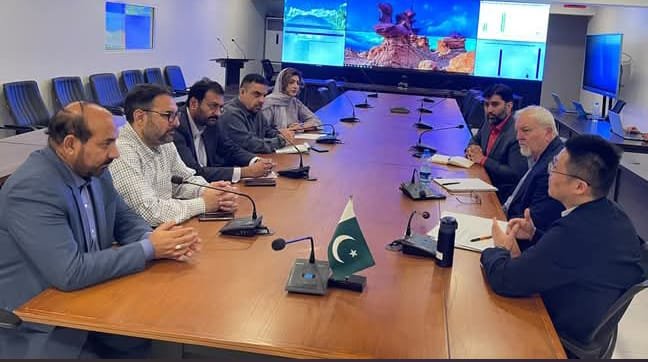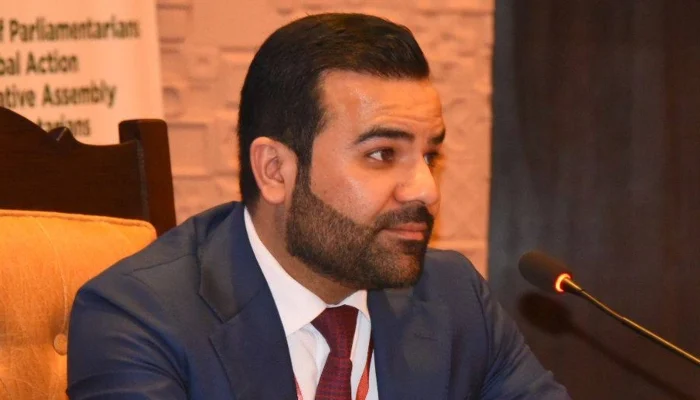
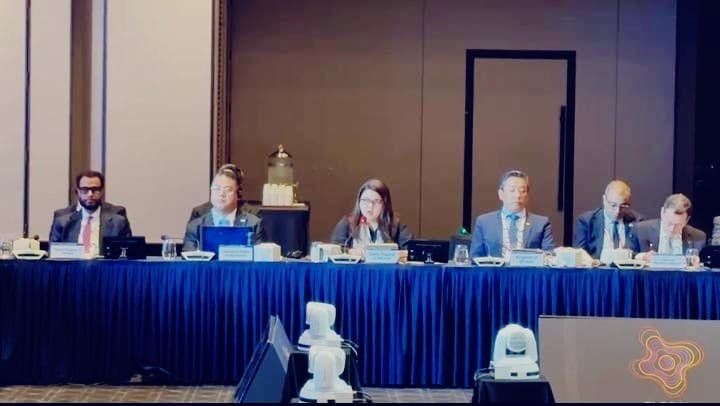
ISLAMABAD, Oct 19 (APP):Federal Minister for Information Technology and Telecommunication Shaza Fatima Khawaja, Monday, delivered a key address titled “Digital and AI Compacts: From Ambition to Action” at the “Global AI & Digital Summit” held in Seoul, South Korea.
Opening her address, the Federal Minister stated that in her three-year tenure as Minister, the most important lesson she learned regarding Artificial Intelligence (AI) in the public sector is that “starting before you are fully ready” is a foundational capability that governments must acquire.
Quoting the UN Secretary-General’s warning that our institutions are not prepared for decision-making machines, she emphasized that preparing ourselves to move from ambition to action is imperative.
The Federal Minister presented four key lessons from Pakistan’s experience in managing this technological and digital transition:
First, create a single owner and head for the compact.
She noted that previously, over a hundred government entities in Pakistan operated in silos. To overcome this, Parliament passed the “Digital Nation Pakistan Act 2025,” establishing the National Digital Commission headed by the Prime Minister, comprising four provincial Chief Ministers, key regulators, and the Digital Authority.
The Prime Minister approved the “National Digital Master Plan,” which covers the digitization of 12 priority sectors through 2035. She stressed that ownership at the highest level alone can overcome traditional inertia.
Second, build pathways that include everyone. Pakistan is developing a Data Exchange Layer, Digital Identity, and Unified Payment Interface as a single interoperable national architecture.
As a rule, data will only be shared, never copied or stored, and will always be subject to citizen consent and a transparent record.
She cited the example of registering over 1 million women-led farms in the agriculture sector and addressing their energy needs.
Alongside the digitization of small and medium enterprises (SMEs), 57 national standards have been established for the private sector to facilitate easy access to the government.
Third, govern the state first. To rebuild public trust, proposed protective legislation mandates the labeling of synthetic/AI content, grants every citizen the right to human review for decisions influenced by AI, and requires government entities to register AI systems and assess their impact before deployment.
Fourth, what gets measured gets improved. Pakistan improved by 14 places in the UN E-Government Index 2024, moving from 150th to 136th position. In this context, every federal secretary will be accountable to the Commission on an annual basis for their ministry’s digital scorecard.
In the subsequent part of her speech, the Federal Minister highlighted key financial and educational initiatives.
She announced a USD 1 billion financial commitment for AI through 2030 by the Prime Minister of Pakistan.
Furthermore, AI and digital training are being provided to 1 million non-IT professionals, alongside 1,000 fully funded AI PhD scholarships. Referring to the “Islamabad AI Declaration,” she noted that 9 principles for sovereign and responsible AI have been set, under which the digital workforce is being quadrupled in just one year.
Highlighting Pakistan’s global role across borders, she shared that Pakistan holds the presidency of the Digital Cooperation Organization (DCO), which approved the ‘Regional DPI Initiative’ proposed by Pakistan. She announced that upon completion of its national stack, Pakistan will offer it free of cost to other countries in need.
Focusing on Sovereign AI, she cited a scientific panel report warning that reliance on foreign AI models leads to a loss of local control. Pakistan is concentrating on “Sovereign AI” that speaks our language, understands our cultural nuances, and advises in our best interest. She also welcomed the UN Secretary-General’s ‘Global Fund for AI.’
Concluding her speech, the Minister remarked that the Digital Compact is our declaration of independence in the digital era, and from Islamabad to Seoul, we are proving that the future belongs to those who code it with sovereignty and inclusion.
Source: APP (Associated Press of Pakistan)