
UNITED NATIONS, Oct 30 (APP):Pakistan has called for urgent, collective global action to strengthen climate adaptation, build disaster resilience, and fully capitalize the Loss and Damage Fund to support vulnerable nations facing escalating environmental crises.
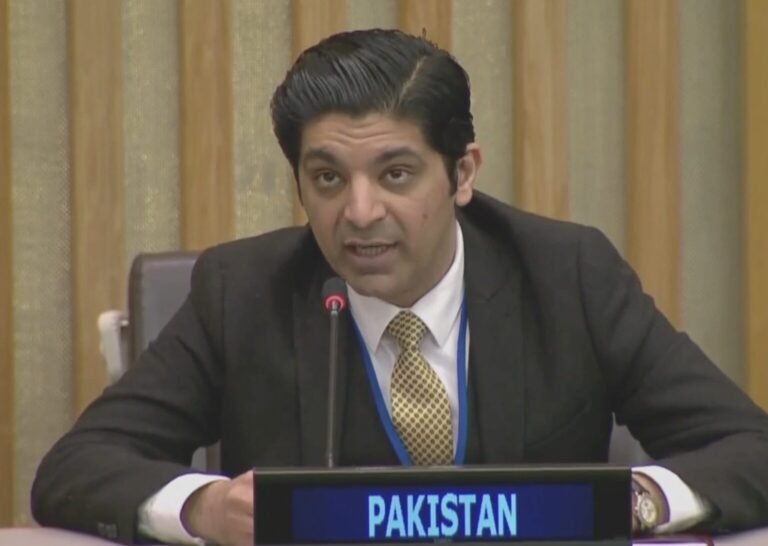
“Climate-vulnerable populations must not be left to bear the consequences of a crisis they did little to create,” Pakistani delegate Saad Ahmad said in an interactive dialogue with the United Nations Special Rapporteur on Climate Change, Elisa Morgera, in the UN General Assembly’s Third Committee, which deals with social, humanitarian and cultural issues.
He was commenting on Ms. Morgera’s report calling for global action to confront mounting environmental threats that adversely impact on human rights and ecosystems.
“Despite contributing less than 1 per cent of global greenhouse gas emissions,” Saad Ahmad, a first secretary in the Pakistan Mission of the UN, said his country remains among the countries most vulnerable to climate change”, as he recalled the devastating floods in 2025 that killed over 1,000 people and displaced approximately 4 million, with $30 billion in damages and economic losses.
The devastation continued in 2025, when floods affected nearly 6.9 million people, claimed over 1,000 lives and displaced more than four million, the Pakistani delegate said.
“These disasters have had far-reaching human rights consequences, undermining the rights to life, health, food, water, adequate housing and education.”
Developing countries, he emphasized, cannot pursue climate objectives at the expense of poverty eradication, energy access and economic growth, saying that climate finance must not deepen the debt burdens of the most vulnerable.
“Grant-based and concessional finance, and an international financial architecture that preserves fiscal space, is essential for enabling equitable climate action,” the Pakistani delegate added.
He agreed with the Special Rapporteur’s concern that carbon-credit mechanisms must not become a substitute for genuine emissions reductions by those with the responsibility.
On its part, Saad Ahmad said Pakistan is investing in ecosystem restoration, water resilience and nature-based solutions.
Earlier, introducing her report, Ms. Morgera, the Special Rapporteur on the promotion and protection of human rights in the context of climate change, warned that the rise in global temperature is now set to cross the 1.5º [celsius] limit, which she said is the scientific and legal threshold against catastrophic climate change impacts.
The special rapporteur criticized the lengths to which States and powerful economic actors are willing to go to protect vested interests in the fossil fuel economy, despite mounting losses of life, worsening food and water insecurity, displacement and rising living costs.
Turning to carbon credits, she challenged their effectiveness as a central component of national climate plans. Growing evidence suggests that carbon markets may, at best, slow emissions growth, sometimes delivering no benefit at all. Some schemes even allow greenhouse gas emissions to rise. “The flaws of carbon markets are not only persistent but, to a significant degree, structural”, she warned, citing harmful consequences for Indigenous Peoples, peasants and rural women.
“Carbon credits are so technically complex and fraught with a lack of transparency that they undermine their human right to information and defy democratic control”, Ms. Morgera added, recalling the Secretary-General’s call to ensure that polluters — namely fossil fuel companies — pay for their climate harm as well as to prevent climate harm caused by unchecked data centre growth.
In that vein, she pointed out that “big tech is a major investor in carbon markets and has made exorbitant profits from selling carbon credits to fossil fuel companies”.
Source: APP (Associated Press of Pakistan)